✨ Why Hope Matters
There’s a reason we’re called Fresh Hope Counselling. Hope is a necessity.
Hope has been described as “an optimistic state of mind that is based on an expectation of desirable outcomes with respect to events and circumstances in one’s own life, or the world at large.”[1]
📊 What the Research Tells Us
Research shows us that people with higher hope levels:
- 📈 Cope better when under stress (Carver & Scheier, 1998).
- 🎓 Achieve more academically or professionally (Snyder et al., 2002).
- 💙 Maintain better physical health and have a lower depression risk (Chang, 1998).
- 🌱 Even in adverse conditions—like serious illness or financial hardship—having a hopeful mindset correlates with greater emotional resilience (Scioli & Biller, 2009).
- 🧠 The brain’s reward system also responds more in hopeful states, producing dopamine surges that energize us to keep going (Volkow & Morales, 2015).
🌱 Three Ways to Cultivate Hope
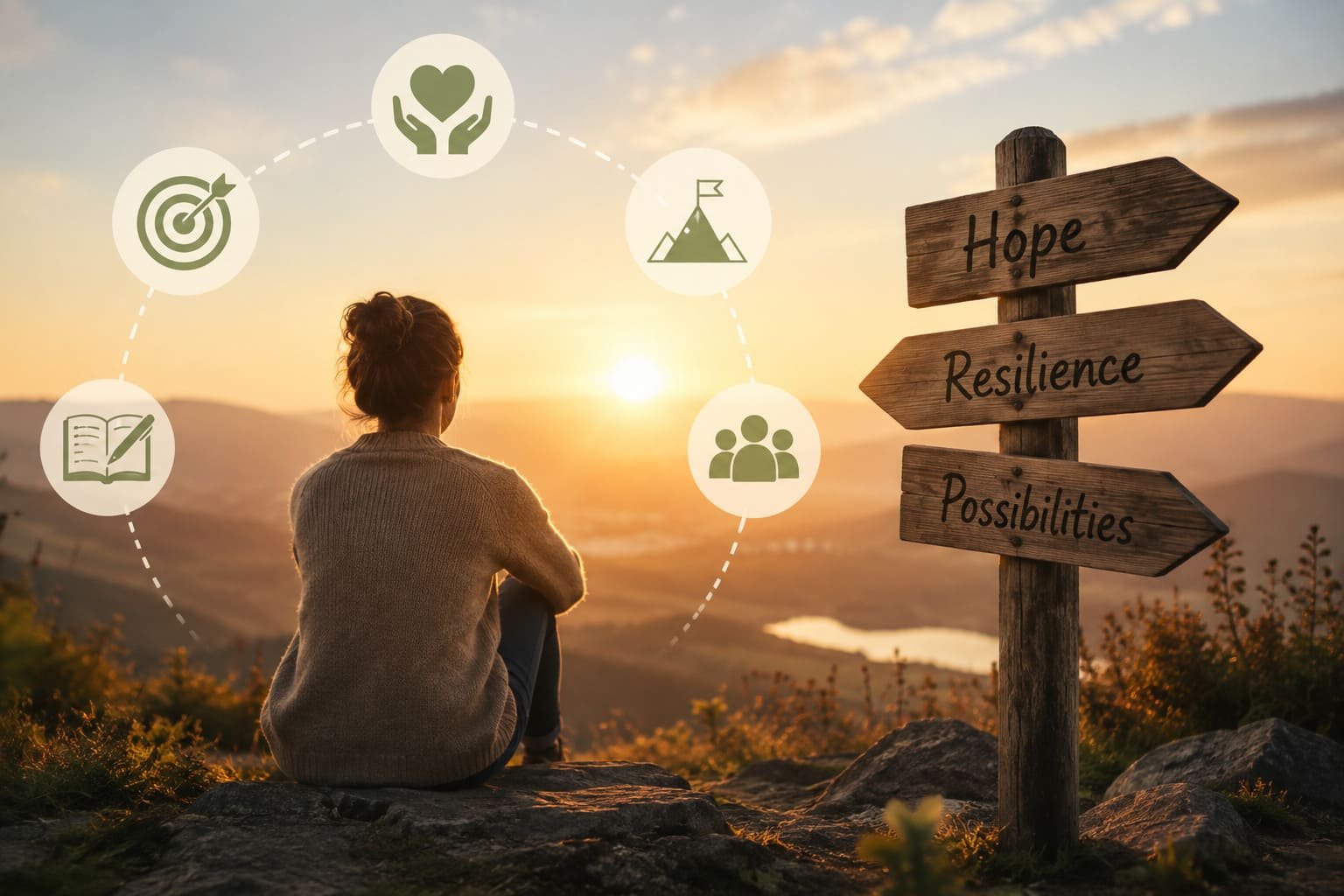
🌿 Reframe the Situations in Life
How we interpret life definitely plays into whether we feel hope-filled or hopeless. To reframe means to look at the challenging parts from a different viewpoint that allows for learning—seeing the potential value that can come from a situation.
It also allows us to see hidden opportunities and the parts that were successful—not an “all or nothing” perspective.
How was this successful? What can I learn from it? What would I do differently next time?
This is where our interpretation can undermine or increase hope. Is our filtering of the event making it more catastrophic, or is it actually accurate and truthful? What meaning can I make from this experience?
🎯 Make Attainable Goals
Setting some attainable goals or steps towards them helps to build hopefulness. This is not wishful thinking but making specific steps that will help move towards success.
Having both hope and viable pathways to move forward is the difference between optimistic thinking and hopeful action.
Evaluate your resources and choose realistic steps so that you can avoid overwhelm.
📖 Keep a Hope Journal
Reflect on any challenges you have had during the day and note how you dealt with them. Take note of the “mini successes” you had during the day—this can include small victories or effective behaviours that you demonstrated.
Visualize what you’d like to continue to see happening in your life. What are your next steps? Realistic and specific are always helpful!
💛 Be Intentional About Your Influences
Who you surround yourself with and what you “ingest” socially, mentally, and emotionally will impact your degree of hope.
Each of us has agency—the ability to initiate and control our actions. It encompasses the belief in one’s capacity to influence one’s own life and circumstances.
It is counter to learned helplessness, where a person starts to believe (and act) as though they have no ability to respond to the circumstances of life, often creating depression and a victim mentality.
This can improve by assessing what you are filling your mind and time with. Who is influencing you? What is influencing your choices? Does it align with your values? Does it help you feel the way you want to be feeling?
If not, use your agency to change up the influences. Be mindful about what you are soaking into your life and ensure that it increases your degree of hope rather than creating cynicism or negativity.
🌟 Choosing Hope Every Day
Hope is a very worthwhile pursuit. It helps us find joy and comfort. Take an assessment of your life and determine if you need to be cultivating more hope.
📚 Sources
- Wikipedia contributors. Hope. Wikipedia, The Free Encyclopedia. https://en.wikipedia.org/wiki/Hope
- Carver, C. S., & Scheier, M. F. (1998). On the Self-Regulation of Behavior. Cambridge University Press.
- Snyder, C. R., Rand, K. L., & Sigmon, D. R. (2002). Hope theory: A member of the positive psychology family. In C. R. Snyder & S. J. Lopez (Eds.), Handbook of Positive Psychology (pp. 257–276). Oxford University Press.
- Chang, E. C. (1998). Hope, problem-solving ability, and coping in a college student population: Some implications for theory and practice. Journal of Clinical Psychology, 54(7), 953–962.
- Scioli, A., & Biller, H. B. (2009). Hope in the Age of Anxiety. Oxford University Press.
- Volkow, N. D., & Morales, M. (2015). The Brain on Drugs: From Reward to Addiction. Cell, 162(4), 712–725.